
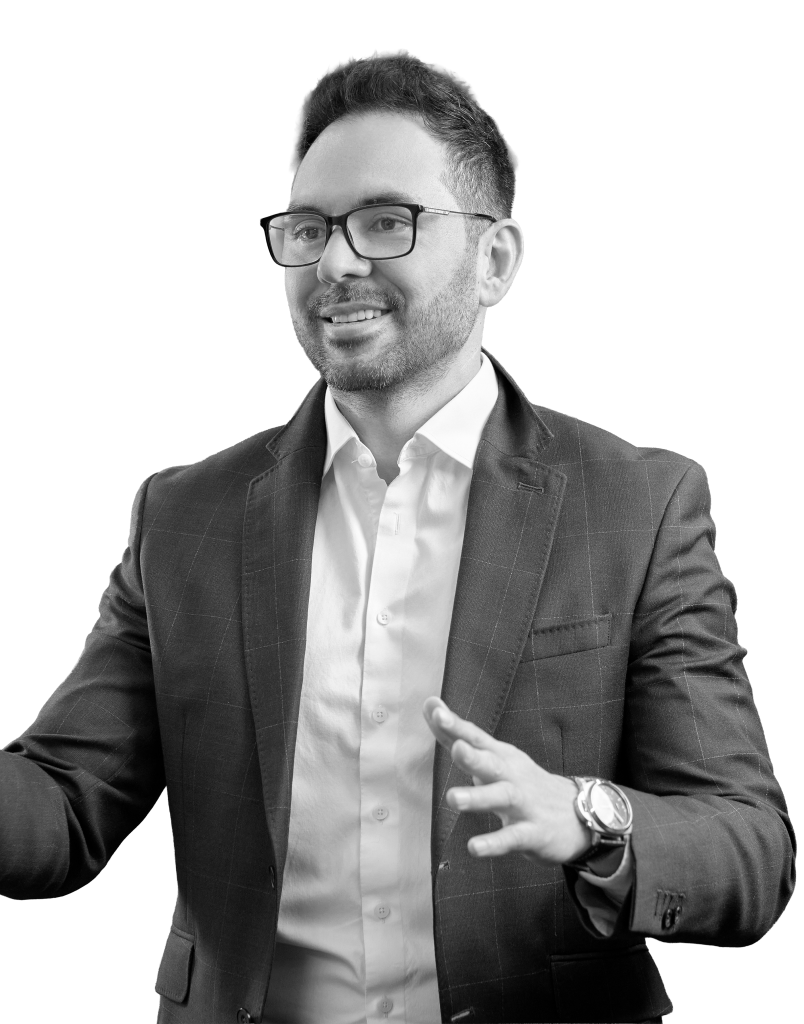
Felipe Rayo
Head of Global Distribution & Customer Logistics, Johnson & Johnson
Some leaders build careers by climbing corporate ladders. Others build them by carrying a deeper sense of purpose into every room they enter. Felipe Rayo belongs firmly in the second category. His story is not simply one of executive success, global leadership, or professional ambition. It is a story about resilience, identity, and the decision to use business not only as a vehicle for profit, but as a force for dignity, opportunity, and human change.
At the heart of Rayo’s story is a personal transformation that began in childhood. When he was eleven years old, his father left home and never returned. In the emotional aftermath of that rupture, he made a powerful internal decision: he would no longer identify with the name his father used for him. Instead, he chose Rayo, his second name, as an alter ego of strength, survival, and reinvention. In many ways, that choice became symbolic of the life he would go on to lead. At an age when most children are still learning who they are, Rayo was already stepping into responsibility, becoming, as he describes it, “the guy of the house,” helping balance the family, guide his mother, and hold together a fragile household.
That early experience shaped more than his identity. It shaped his leadership. It taught him that responsibility is not abstract. It is truly lived. It is often quiet. And it often begins long before anyone else notices it.
Years later, that same instinct for responsibility would find expression in the world of sustainability. But for Rayo, sustainability was never just about carbon metrics, compliance, or corporate image. It began, first and foremost, with people.
Raised in Colombia, he understood intimately the realities of an emerging economy where beauty and hardship often coexist. Colombia is globally celebrated for its coffee, but behind that industry are communities that have often faced unequal living conditions, dangerous working environments, and deeply imbalanced household structures. In many rural communities, men were the primary economic providers through coffee labor, while women carried the invisible weight of domestic life: raising children, managing households, and often contributing to the harvest itself, all without meaningful financial independence or recognition.
It was in this setting that Rayo’s understanding of sustainability first took shape. In one of his earliest professional experiences, he worked on an initiative designed to create jobs for women and daughters in coffee-growing communities in Colombia’s remote mountain regions. Rather than allowing families to depend solely on the unstable and difficult economics of coffee farming, the project brought apparel manufacturing into these areas. Through partnerships connected to major global brands, garments were assembled in rural Colombia, creating dignified paid work for women who had previously been confined to unpaid domestic labor and agricultural support roles.
This was not sustainability as a slogan. It was sustainability as social transformation. Rayo traveled directly into these communities, often spending hours in rugged transport, climbing into small vehicles through mountainous roads and volatile regions to meet people where they lived. He was not observing change from a distance; he was inside it. He saw firsthand how job creation could alter the balance of a household, expand the possibilities for women, and create a more stable future for children. He also saw how global commerce, when directed thoughtfully, could become a tool for empowerment rather than extraction.
That experience left a permanent mark. It sparked what he describes as the beginning of his sustainability mindset: not just an awareness of environmental impact, but a deeper commitment to ensuring that business decisions create social value.
From there, Rayo carried that mindset into every chapter of his career. Across industries ranging from beverages to pharmaceuticals to global manufacturing, he consistently approached leadership with the same question: how can a company achieve its goals while also improving the lives of the communities around it? That philosophy is evident in the examples he shares from later in his career. At Pirelli, he helped establish the first global distribution center in Colombia for Latin America, creating jobs and investment in his home country. In the brewing industry, he helped bring large-scale production into Panama, building local capability, manufacturing infrastructure, and employment. During COVID, he supported major operational investment in Tennessee, again ensuring that growth translated into tangible local opportunity.
This is what distinguishes Rayo’s leadership. He does not see sustainability as a parallel function, separate from business performance. He sees it as embedded in decision-making itself. Every supply chain project, every investment, every facility, every operational shift carries consequences beyond the bottom line. For him, leadership means taking responsibility for those consequences.
That ethic has followed him into Johnson & Johnson, where he now serves in a major global supply chain role. For Rayo, joining the company was the fulfillment of a long-held ambition. Johnson & Johnson, he says, represented a gold standard, an organization known not only for scale, but for a deeply rooted culture of responsibility. What drew him most powerfully was the company’s Credo, a foundational statement that has guided the company for more than a century and explicitly includes responsibility to society and the environment.
That alignment matters. Rayo speaks not as someone performing corporate talking points, but as someone who genuinely identifies with the values behind them.
Within his work today, sustainability takes many forms. It includes environmentally conscious packaging, safer and more efficient product delivery, responsible water use, land stewardship, and significant efforts to reduce carbon emissions across the supply chain. One of the clearest examples he offers is the shift away from air transportation toward ocean freight wherever possible—a major operational decision that reflects the company’s commitment to lowering the carbon footprint of global distribution. In highly regulated healthcare environments, where packaging and logistics must meet the highest safety standards, that balance is not simple. Yet Felipe sees the challenge clearly: cost, safety, and sustainability must all coexist.
Still, even in a company with strong environmental commitments, Rayo never loses sight of the human dimension. He believes social sustainability must stand alongside environmental progress. A responsible executive, in his view, cannot think only in terms of efficiency and profitability. Leadership must also ask what benefits are being created for communities, what dignity is being preserved for workers, and what kind of future is being built for the next generation.
That future is personal to him. As a father to a young daughter, he views sustainability not as a trend, but as an obligation. The climate crisis, water scarcity, energy choices, manufacturing systems—these are not abstract policy concerns. They are questions about the kind of world children will inherit. He returns again and again to the same core belief: daily actions matter. People should never underestimate the impact of what they do each day, whether in the boardroom, in the shower, in the kitchen, or in the way they consume resources.
For Rayo, consistency is everything. True character is not defined by what people do when they are seen, but by what they do when no one is watching. That philosophy explains why he has often preferred to work quietly, without seeking the spotlight. Yet he is also coming to recognize that telling the story matters too. Not for ego, but for influence. By sharing what is possible, leaders can inspire others to lead with greater purpose.
In the end, Rayo’s life offers a compelling definition of sustainability: it is not just about protecting resources, but about honoring human value. It is about being present, staying mindful, and making decisions that serve enterprise. It is about understanding that leadership is not only measured by results, but by the lives changed along the way.
And perhaps most of all, it is about turning pain into purpose and using that purpose to build something better for others.