
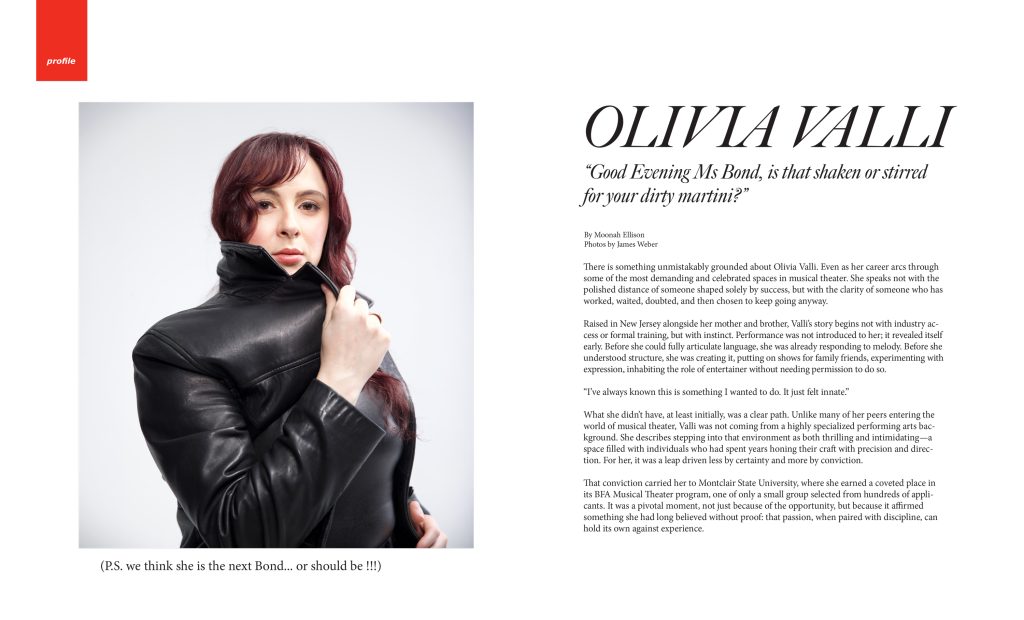
By Moonah Ellison
Photos by James Weber
There is something unmistakably grounded about Olivia Valli. Even as her career arcs through some of the most demanding and celebrated spaces in musical theater. She speaks not with the polished distance of someone shaped solely by success, but with the clarity of someone who has worked, waited, doubted, and then chosen to keep going anyway.
Raised in New Jersey alongside her mother and brother, Valli’s story begins not with industry access or formal training, but with instinct. Performance was not introduced to her; it revealed itself early. Before she could fully articulate language, she was already responding to melody. Before she understood structure, she was creating it, putting on shows for family friends, experimenting with expression, inhabiting the role of entertainer without needing permission to do so.
“I’ve always known this is something I wanted to do. It just felt innate.”
What she didn’t have, at least initially, was a clear path. Unlike many of her peers entering the world of musical theater, Valli was not coming from a highly specialized performing arts background. She describes stepping into that environment as both thrilling and intimidating—a space filled with individuals who had spent years honing their craft with precision and direction. For her, it was a leap driven less by certainty and more by conviction.
That conviction carried her to Montclair State University, where she earned a coveted place in its BFA Musical Theater program, one of only a small group selected from hundreds of applicants. It was a pivotal moment, not just because of the opportunity, but because it affirmed something she had long believed without proof: that passion, when paired with discipline, can hold its own against experience.
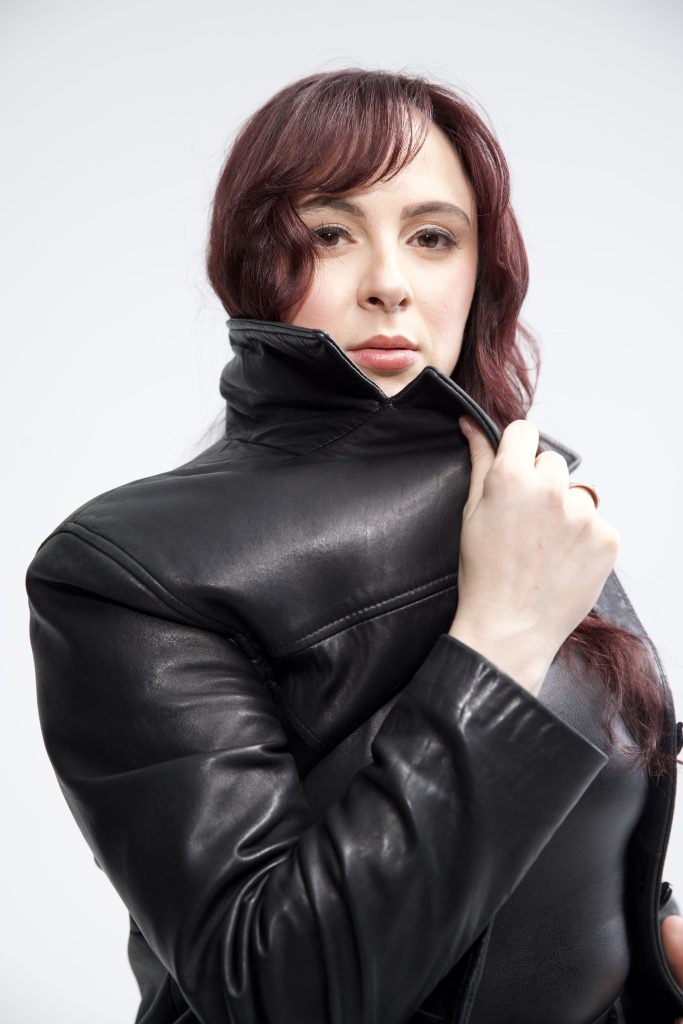
From there, the trajectory was anything but immediate. Her first major professional breakthrough came with Wicked—a defining moment for many performers, but for Valli, it arrived with a delay that would ultimately shape her perspective. After initially being told she was “not yet ready,” she spent a year navigating uncertainty, working as a wedding band singer while watching peers book roles. It was a period marked by self-questioning, a quiet recalibration of expectations.
Then the call came back.
“They didn’t say no. They said not yet and that changed everything for me.”
Cast as the understudy for Elphaba on the national tour, Valli entered one of the most demanding roles in modern musical theater, not as the lead, but as the performer who must always be ready to become the lead at a moment’s notice. It required endurance, patience, and a level of preparation that often goes unseen. For a full year, she rehearsed, observed, and absorbed before stepping into the role on stage.
That debut, when it came, was not defined by fear but by readiness.
“I waited a full year to go on as Elphaba, and by then, I wasn’t scared. I was ready.”
What followed was three years on the road, a period she describes as her greatest education. It was there she learned not just the mechanics of performance, but the deeper discipline of being a professional—how to stay present, how to remain humble, how to recognize that growth.
And yet, even after such a significant milestone, the question that shadows every artist resurfaced: what comes next?
Post-Wicked, Valli faced a different kind of pressure, not the struggle to break in, but the challenge of sustaining momentum. She speaks candidly about the internal dialogue that follows a major success, the fear of becoming defined by a single role. Her response was not to chase validation, but to refine her approach.
“I stopped trying to prove anything and focused on doing honest, grounded work.” That mindset carried her into the next chapter of her career, including her role in Jersey Boys, a production she auditioned for over the course of seven years. The persistence required for that kind of pursuit is emblematic of her journey: steady, unglamorous, and ultimately rewarded.
Then came an unexpected interruption: the global pause of the pandemic.
Like many performers, Valli found herself in a moment of forced stillness, a rare break in an otherwise relentless cycle of auditions and performances. It was during this time that the industry itself began to shift, introducing new formats like self-taped auditions, requiring performers to adapt not just creatively, but technically.
Her return to auditioning led to one of her most prominent roles yet: Vivian in the national tour of Pretty Woman: The Musical, where she starred opposite Adam Pascal. The role demanded not only vocal and emotional range, but ownership, taking a character widely known through film and reinterpreting it for the stage.
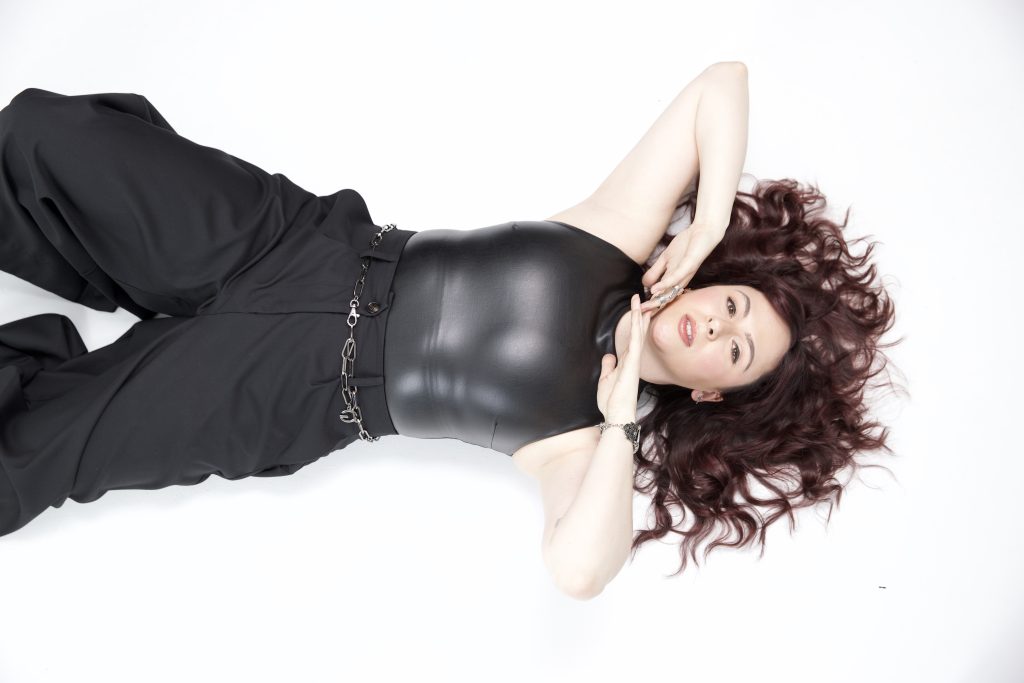
“If you want to see Julia Roberts, go watch the movie. I had to make Vivian my own.”
That ownership extended beyond performance into identity. Valli speaks openly about not fitting into traditional or “Eurocentric” standards of beauty, and how that reality shaped her understanding of self within the industry. Rather than resist it, she reframed it, finding affirmation in the act of performing itself.
“It felt like nightly affirmations. I know what I bring, and I stand in that.”
As her career continues to evolve, Valli’s ambitions remain expansive. She expresses a desire to originate new work, to explore film and television, and even to step behind the camera as a director. Driven not by a need to diversify for the sake of it, but by a genuine curiosity about storytelling in all its forms.
Creativity, for her, is not confined to one medium. It is a continuous process.
“I want creativity to pour out of me. I don’t want to limit where that can go.”
At the same time, she maintains a clear boundary between her professional and personal life, particularly in an era dominated by social media. While acknowledging its role in modern visibility, she remains cautious, prioritizing privacy and authenticity over constant exposure.
Her perspective is shaped by experience, by witnessing both the benefits and the risks of digital accessibility. It is a stance that feels increasingly rare and increasingly intentional.
Even her views on emerging technologies, including AI, reflect a deeper concern for the integrity of artistic creation. While she recognizes its inevitability, she questions its impact on originality, on craftsmanship, and on the human element that defines performance.
For Valli, the essence of art lies in lived experience, the ability to translate reality into something shared. And that, ultimately, is what defines her journey. Not just the roles, or the milestones, or even the breakthroughs, but the persistence behind them. The willingness to wait. The discipline to grow. And the clarity to remain rooted in why she started in the first place.
In an industry often defined by immediacy, Valli represents something far more enduring: the quiet power of staying the course.
CREDITS:
Photos by James Weber
Camera BTS: Cris Pena
Stylist: Sahil Babar
Hair & Makeup: Marta Noronha& Romana