
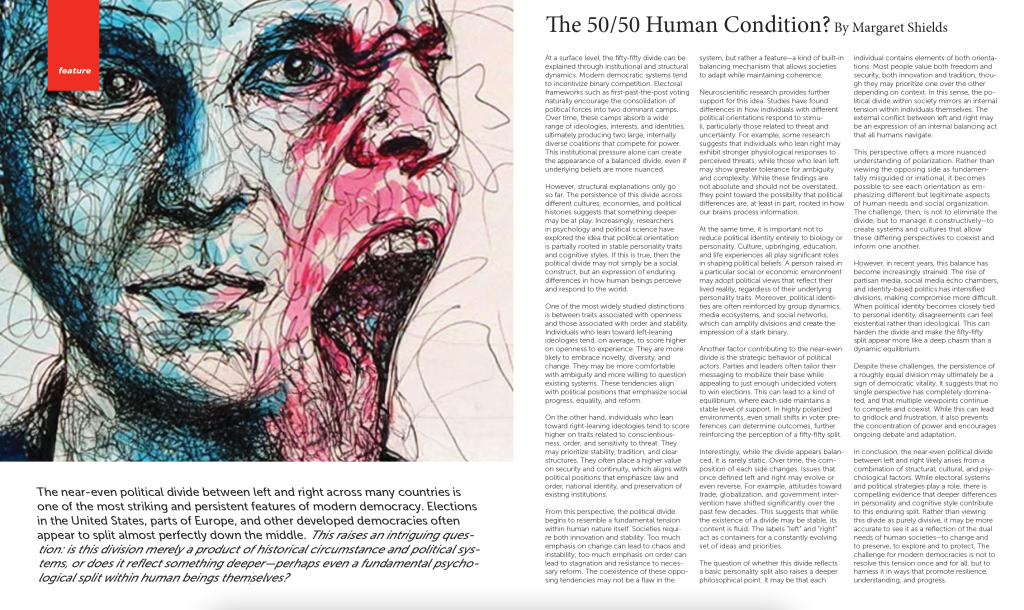
The near-even political divide between left and right across many countries is one of the most striking and persistent features of modern democracy. Elections in the United States, parts of Europe, and other developed democracies often appear to split almost perfectly down the middle. This raises an intriguing question: is this division merely a product of historical circumstance and political systems, or does it reflect something deeper—perhaps even a fundamental psychological split within human beings themselves?
By Margaret Shields
At a surface level, the fifty-fifty divide can be explained through institutional and structural dynamics. Modern democratic systems tend to incentivize binary competition. Electoral frameworks such as first-past-the-post voting naturally encourage the consolidation of political forces into two dominant camps. Over time, these camps absorb a wide range of ideologies, interests, and identities, ultimately producing two large, internally diverse coalitions that compete for power. This institutional pressure alone can create the appearance of a balanced divide, even if underlying beliefs are more nuanced.
However, structural explanations only go so far. The persistence of this divide across different cultures, economies, and political histories suggests that something deeper may be at play. Increasingly, researchers in psychology and political science have explored the idea that political orientation is partially rooted in stable personality traits and cognitive styles. If this is true, then the political divide may not simply be a social construct, but an expression of enduring differences in how human beings perceive and respond to the world.
One of the most widely studied distinctions is between traits associated with openness and those associated with order and stability. Individuals who lean toward left-leaning ideologies tend, on average, to score higher on openness to experience. They are more likely to embrace novelty, diversity, and change. They may be more comfortable with ambiguity and more willing to question existing systems. These tendencies align with political positions that emphasize social progress, equality, and reform.
On the other hand, individuals who lean toward right-leaning ideologies tend to score higher on traits related to conscientiousness, order, and sensitivity to threat. They may prioritize stability, tradition, and clear structures. They often place a higher value on security and continuity, which aligns with political positions that emphasize law and order, national identity, and preservation of existing institutions.
From this perspective, the political divide begins to resemble a fundamental tension within human nature itself. Societies require both innovation and stability. Too much emphasis on change can lead to chaos and instability; too much emphasis on order can lead to stagnation and resistance to necessary reform. The coexistence of these opposing tendencies may not be a flaw in the system, but rather a feature—a kind of built-in balancing mechanism that allows societies to adapt while maintaining coherence.
Neuroscientific research provides further support for this idea. Studies have found differences in how individuals with different political orientations respond to stimuli, particularly those related to threat and uncertainty. For example, some research suggests that individuals who lean right may exhibit stronger physiological responses to perceived threats, while those who lean left may show greater tolerance for ambiguity and complexity. While these findings are not absolute and should not be overstated, they point toward the possibility that political differences are, at least in part, rooted in how our brains process information.
At the same time, it is important not to reduce political identity entirely to biology or personality. Culture, upbringing, education, and life experiences all play significant roles in shaping political beliefs. A person raised in a particular social or economic environment may adopt political views that reflect their lived reality, regardless of their underlying personality traits. Moreover, political identities are often reinforced by group dynamics, media ecosystems, and social networks, which can amplify divisions and create the impression of a stark binary.
Another factor contributing to the near-even divide is the strategic behavior of political actors. Parties and leaders often tailor their messaging to mobilize their base while appealing to just enough undecided voters to win elections. This can lead to a kind of equilibrium, where each side maintains a stable level of support. In highly polarized environments, even small shifts in voter preferences can determine outcomes, further reinforcing the perception of a fifty-fifty split.
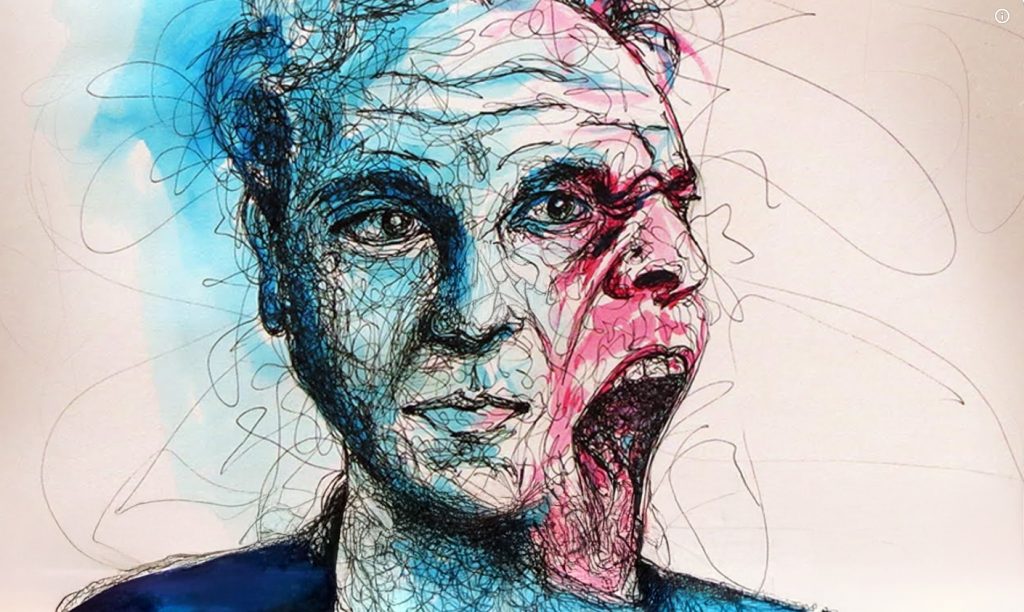
Interestingly, while the divide appears balanced, it is rarely static. Over time, the composition of each side changes. Issues that once defined left and right may evolve or even reverse. For example, attitudes toward trade, globalization, and government intervention have shifted significantly over the past few decades. This suggests that while the existence of a divide may be stable, its content is fluid. The labels “left” and “right” act as containers for a constantly evolving set of ideas and priorities.
The question of whether this divide reflects a basic personality split also raises a deeper philosophical point. It may be that each individual contains elements of both orientations. Most people value both freedom and security, both innovation and tradition, though they may prioritize one over the other depending on context. In this sense, the political divide within society mirrors an internal tension within individuals themselves. The external conflict between left and right may be an expression of an internal balancing act that all humans navigate.
This perspective offers a more nuanced understanding of polarization. Rather than viewing the opposing side as fundamentally misguided or irrational, it becomes possible to see each orientation as emphasizing different but legitimate aspects of human needs and social organization. The challenge, then, is not to eliminate the divide, but to manage it constructively—to create systems and cultures that allow these differing perspectives to coexist and inform one another.
However, in recent years, this balance has become increasingly strained. The rise of partisan media, social media echo chambers, and identity-based politics has intensified divisions, making compromise more difficult. When political identity becomes closely tied to personal identity, disagreements can feel existential rather than ideological. This can harden the divide and make the fifty-fifty split appear more like a deep chasm than a dynamic equilibrium.
Despite these challenges, the persistence of a roughly equal division may ultimately be a sign of democratic vitality. It suggests that no single perspective has completely dominated, and that multiple viewpoints continue to compete and coexist. While this can lead to gridlock and frustration, it also prevents the concentration of power and encourages ongoing debate and adaptation.
In conclusion, the near-even political divide between left and right likely arises from a combination of structural, cultural, and psychological factors. While electoral systems and political strategies play a role, there is compelling evidence that deeper differences in personality and cognitive style contribute to this enduring split. Rather than viewing this divide as purely divisive, it may be more accurate to see it as a reflection of the dual needs of human societies—to change and to preserve, to explore and to protect. The challenge for modern democracies is not to resolve this tension once and for all, but to harness it in ways that promote resilience, understanding, and progress.