
By Brinlee Edger
Images by Ashley Nguyen
Logan Browning has spent much of her career portraying women who live in the gray areas between certainty and contradiction. From Dear White People to Harlem, her characters rarely offer easy answers. Her latest role continues that tradition.
In Netflix’s limited series I Will Find You, adapted from Harlan Coben’s bestselling novel, Browning stars alongside Sam Worthington, Britt Lower, and Milo Ventimiglia in a thriller about David Burroughs, a father imprisoned for the murder of his son before evidence suggests the child may still be alive. Browning plays Sarah Greer, a key figure in a story built on grief, suspicion, and the fragility of certainty.
Yet I Will Find You also arrives during a period of transformation for Browning herself. While continuing her acting career, she is completing a degree in Film and Media Studies, deepening an interest that extends beyond performance to how stories are created, distributed, and experienced.
“I’m fascinated by television,” she says. “I’m fascinated by this thing that came into the home and became part of our intimate lives.”
That perspective shapes how she views her work. Rather than focusing on celebrity, Browning sees television as a uniquely personal medium.
“It’s why I love being on television,” she explains. “You become part of the family.”
Her role in I Will Find You began with a traditional audition, something she still enjoys after years in the industry. She appreciated meeting producers over video, which restored some of the collaboration lost through self-taped auditions. Before production, Browning immersed herself in Harlan Coben’s work, quickly discovering the devoted audience surrounding his thrillers before relocating to Toronto for filming.
Learning has become the defining thread throughout her career. Raised in Atlanta, Browning grew up immersed in the arts. She studied ballet from an early age, attended theatre programs at the Alliance Theatre with her brother, and regularly experienced live performances with her family. Church introduced another form of storytelling through music and performance.
Professional acting arrived unexpectedly when her mother enrolled her in Barbizon at fourteen to build confidence. After being discovered at a competition attended by talent agents, Browning faced an extraordinary question from her parents: was she ready to move to Los Angeles?
“I felt like I had to say yes for every child on the planet,” she recalls.
Within months, auditions and production schedules replaced a conventional teenage life. Throughout it all, her parents remained deeply involved, ensuring work never came at the expense of stability or education. That foundation became even more meaningful after her father’s death twelve years ago.
“You hold memories of your loved one that’s passed,” she says. “You can see and hear your loved one in your siblings and in your parent that is still living.”

Family and community remain central to Browning’s outlook, both personally and professionally. Even after building a résumé many actors would envy, she continues approaching each project with the mindset of a student.
That curiosity now extends behind the camera. Browning hopes to direct, viewing filmmaking as the natural next step after years spent observing every aspect of production. She has already directed the short film Hey Boo in 2023 through Kevin Hart’s Heartbeat Productions’ Women Write Now initiative and plans to pursue graduate studies in directing and filmmaking.
“The goal is to study directing and filmmaking,” she says.
Her interest lies in collaboration rather than control. She speaks of filmmaking as a collective effort where every contribution matters.
That philosophy became especially important during Dear White People, the Netflix series that transformed her career. As the show’s lead actor, Browning viewed leadership not as authority but as responsibility. She made a point of welcoming guest actors, rehearsing scenes when needed, and ensuring newcomers felt supported from their first day on set.
“I wanted everyone to know that they had an advocate in me,” she says.
The series also changed her relationship with public life. Interviews increasingly shifted away from acting toward discussions of race, identity, and representation.
“It thrust me into this world of, ‘Who am I as Logan?’”
That question continues to shape how she approaches both her work and the rapidly changing media landscape.
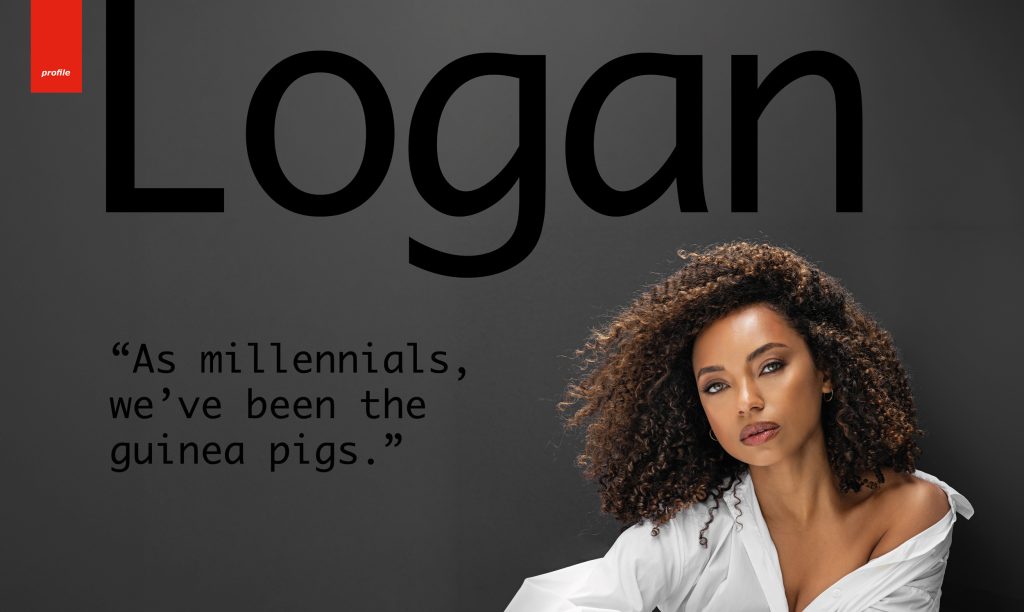
Artificial intelligence, she believes, deserves thoughtful engagement rather than unquestioning optimism or outright rejection. “As millennials, we’ve been the guinea pigs,” she says, reflecting on a generation that witnessed personal computers, smartphones, social media, streaming, and now AI fundamentally reshape daily life.
She acknowledges AI’s practical benefits and has experimented with tools introduced through her university coursework. But she also worries about unintended consequences.
“If I can build my own website,” she asks, “am I taking someone else’s job?”
She points to research showing that while AI-assisted users became better at identifying misinformation, their own critical thinking declined once the technology was removed.
“Our overuse of these things, while they are helpful in the short term, are taking our mental tools away from us,” she says.
Rather than rejecting technology, Browning believes creatives must learn to work alongside it while preserving independent thought. The same philosophy informs her relationship with social media. Several years ago, she disabled nearly every notification on her phone. “I choose when I go on,” she says.
She still catches herself instinctively opening Instagram, but the habit only reinforces her awareness of how technology shapes attention. Meditation, often through the Insight Timer app, has become one way of creating intentional space away from constant digital stimulation.
As both an actor and a media studies student, Browning also finds social media fascinating as an evolving cultural phenomenon. She studies not only how platforms change but how audiences and storytelling evolve alongside them.
Throughout the conversation, one idea surfaces repeatedly: agency. Whether discussing education, directing, AI, family, or social media, Browning believes people retain the ability to choose how they engage with the world.
She recalls being asked as a teenager what fame meant to her. Her answer has not changed.
“I wanted to make a name for myself so I could change the world.” Today, she adds, “I don’t want it to just be because it’s me. That seems so pointless.”
For Browning, visibility matters only if it creates something beyond self-promotion. Success is measured less by recognition than by whether the work leaves audiences thinking differently.
That perspective makes I Will Find You feel like more than another credit in an accomplished career. It represents another opportunity to tell stories that connect with people and invite reflection.
After more than fifteen years in the entertainment industry, Browning’s defining quality is not simply longevity or versatility, but curiosity. The questions that brought a fourteen-year-old from Atlanta to Los Angeles remain unchanged. She still wants to understand how stories work, challenge herself creatively, and continue learning.
In an industry that often rewards certainty over authenticity, Logan Browning remains remarkably comfortable with curiosity—and that willingness to keep learning may be what makes her one of Hollywood’s most compelling storytellers.