
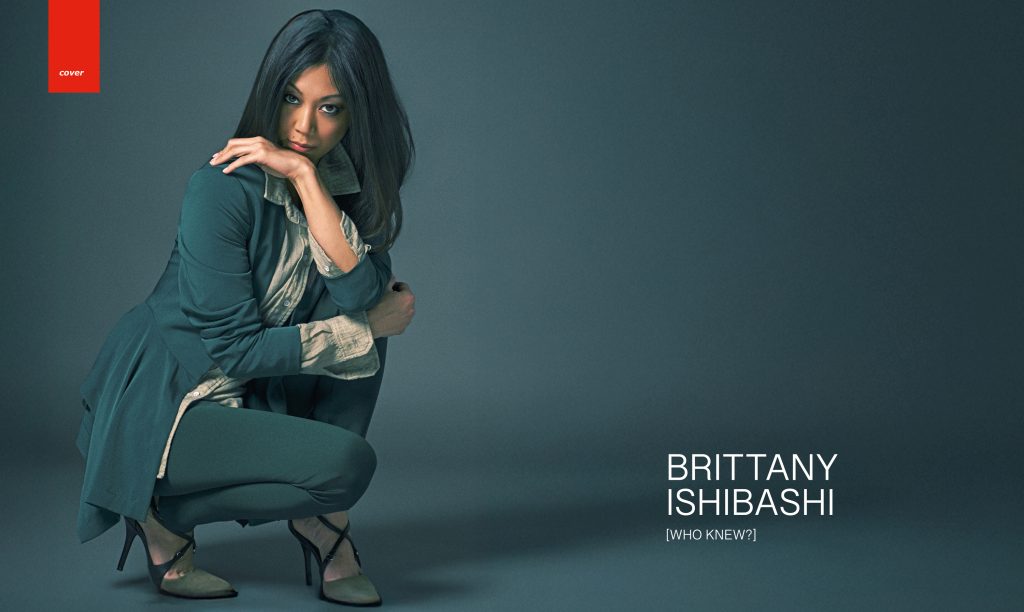
By Moonah Ellison
Photos by The Riker Brothers
Brittany Ishibashi no longer believes in work-life balance. Not in the neat, evenly divided version of it, anyway—the version in which ambition, marriage, motherhood and creative work coexist without inconvenience, resentment or the occasional three-in-the-morning spiral.
“I don’t think that’s possible,” she says. “Something always has to give.” The admission is less defeatist than practical. Ishibashi has three children, a career in front of the camera, a production company and several projects developing behind it. Her family life and creative life do not sit in separate compartments so much as spill continually into one another. The adjustment, she says, has been learning to extend herself some grace when the proportions shift.
“If we do refer to it as some kind of balance, it’s not always going to be equal.”
Some days belong to the work. Others belong to the children. On more difficult nights, they follow her into bed and wake her before dawn, when the house is quiet but her mind is not. She describes the familiar experience of opening her eyes at three in the morning and watching the machinery start up: the unanswered question, the unfinished task, the detail that seemed manageable at midnight and urgent by sunrise.
By five, she says, it is time to get up anyway.
This summer, however, there is a brief opening. Her children are away at camp, and Ishibashi is back in Los Angeles after spending much of the previous year in Austin, Texas, where she filmed Brothers, the Apple TV+ comedy starring Matthew McConaughey and Woody Harrelson as heightened versions of themselves. Ishibashi plays Joy Harrelson, whose daughter’s marriage begins to fall apart. The family responds by retreating to Matthew’s ranch, where open space, enforced closeness and good intentions produce the opposite of peace. the series premieres late September
“It just breeds utter chaos,” Ishibashi says.
The series leans into the decades-long friendship between McConaughey and Harrelson, borrowing from their real histories while exaggerating the mythology that has formed around them. For Ishibashi, the appeal was not simply joining two of the most recognizable actors of their generation. It was discovering how deliberately they made the rest of the ensemble forget that fact.
She had been asked recently whether the two men were everything she hoped they would be. The answer came easily. “Yes, and then some.”
What impressed her most was not charisma, which she expected, or comic timing, which hardly needed proving. It was the amount of work required to make a large production feel loose. McConaughey and Harrelson arrived with the authority to control the room and used it instead to make the room less guarded. They encouraged experimentation. They allowed people to miss. They built enough trust for the actors around them to risk looking foolish, which is often where comedy begins. “It’s a very intentional thing,” Ishibashi says.

The set began to feel less like a star-driven television production than a repertory company. Ideas moved around. Scenes opened up. The hierarchy remained, but it did not dominate the atmosphere. Then, occasionally, the illusion would break. Ishibashi would be midway through a scene and suddenly become aware of whose face was across from hers. “I’m doing a scene with Matthew McConaughey,” she remembers thinking. “Then I’m doing a scene with Woody Harrelson.” The realization would arrive and then pass. There was still a scene to finish.
Comedy has always interested Ishibashi, though her filmography has not often made that obvious. She has spent much of her career in dramas, action projects and genre productions, including the Marvel series Runaways and films such as Teenage Mutant Ninja Turtles: Out of the Shadows. The work established a certain image: controlled, capable, serious.
“I love comedy,” she says. “I just very rarely get cast in it.”
Brothers gave her room to disturb that image. The pleasure was partly in the material and partly in the freedom surrounding it. With its stars playing unruly variations of themselves, the series operated in a space between fiction and inside joke. Stories that sounded invented were often true; the stranger they became, the more likely they were to have originated somewhere in Harrelson and McConaughey’s actual friendship.
There was mischief in that uncertainty. Ishibashi could enter a scene without entirely knowing which part belonged to the script and which part had escaped from somebody’s memory. The experience arrived at a moment when she had been thinking more seriously about permission—who gives it, who waits for it and how much time artists lose by assuming it must come from somewhere else.
In Ishibashi’s family, making art was never treated as a rebellion. Her parents were artists. Her sisters became artists. Creativity was not positioned as the impractical alternative to a respectable life; it was simply the language spoken at home. She and her sisters made up stories, staged performances and put on shows for the neighbors. Art was play before it was profession, and because nobody taught them to regard it as frivolous, the transition from one to the other did not feel especially radical.
“It was something I never questioned not doing,” she says.
That certainty was unusual for a Japanese-American child growing up in Orange County in the 1980s, when creative careers were not always encouraged within Asian-American families. Ishibashi understands the general expectation. She simply did not experience it inside her own house.
Her parents saw art as a way of connecting people. It could be joyful, serious, communal and worthwhile at once. That belief remained with all three daughters, even as their individual work moved in different directions.

Now, the sisters are developing a project inspired by their childhood as three Japanese-American performing artists growing up backstage, where the world adults built for entertainment occasionally exposed them to more than children were meant to understand. The project is still taking shape, but its foundation is familiar: family history, performance and the peculiar intimacy of sisters who have spent their lives sharing both.
Ishibashi calls the family “very codependent,” then laughs. The word sounds more affectionate than clinical. They are closely involved in one another’s work, constantly exchanging ideas and relying on a shorthand that developed long before any of them knew they were building creative careers.
The production company belongs to Ishibashi, but the work around it remains porous. One sister is also developing a project about their grandmother, who was incarcerated at Manzanar during World War II and became known as the “Songbird of Manzanar.”
The story centers on music, confinement and survival—not resistance as spectacle, but resistance practiced quietly enough to be overlooked. Their grandmother used her voice to sustain people inside a place designed to diminish them.
That history complicates the idea that change must arrive through enormous gestures. Sometimes it begins with a song. Sometimes with a room of people who hear it. “Art as resistance,” she says. “The power of hope.”
Those ideas do not feel distant from the projects she wants to produce now. Ishibashi has spent years helping realize other people’s stories. Producing gives her the ability to decide which stories enter the room in the first place, particularly the ones rooted in lives that rarely arrive onscreen without being simplified.
It is not a rejection of acting. She still loves being handed a role she did not imagine for herself, especially one that breaks a pattern the industry has become comfortable repeating. But she is less willing than she once was to let casting determine the limits of her creative identity. “This business can pigeonhole you,” she says. “You have permission to be whatever it is that you want to be.”
For Ishibashi, that permission has become less abstract with age. It looks like comedy after years of dramatic roles. It looks like developing work with her sisters. It looks like allowing family history to become artistic material without reducing it to heritage or obligation. It also looks like accepting that none of it will be balanced.
The work and the family will continue competing for time. The children will grow. Productions will move. Some nights will still end at three in the morning with Ishibashi awake, arranging responsibilities in the dark.
The goal is no longer to force every part of her life into equal portions. It is to remain present inside whichever part needs her most.