By Monica Edison
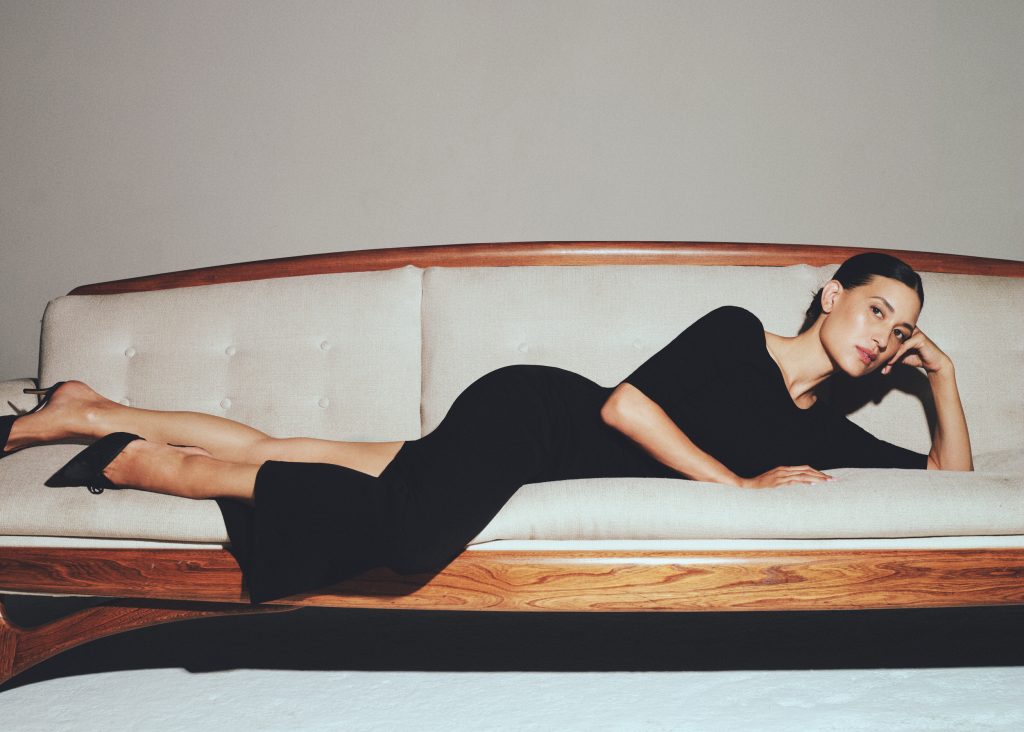
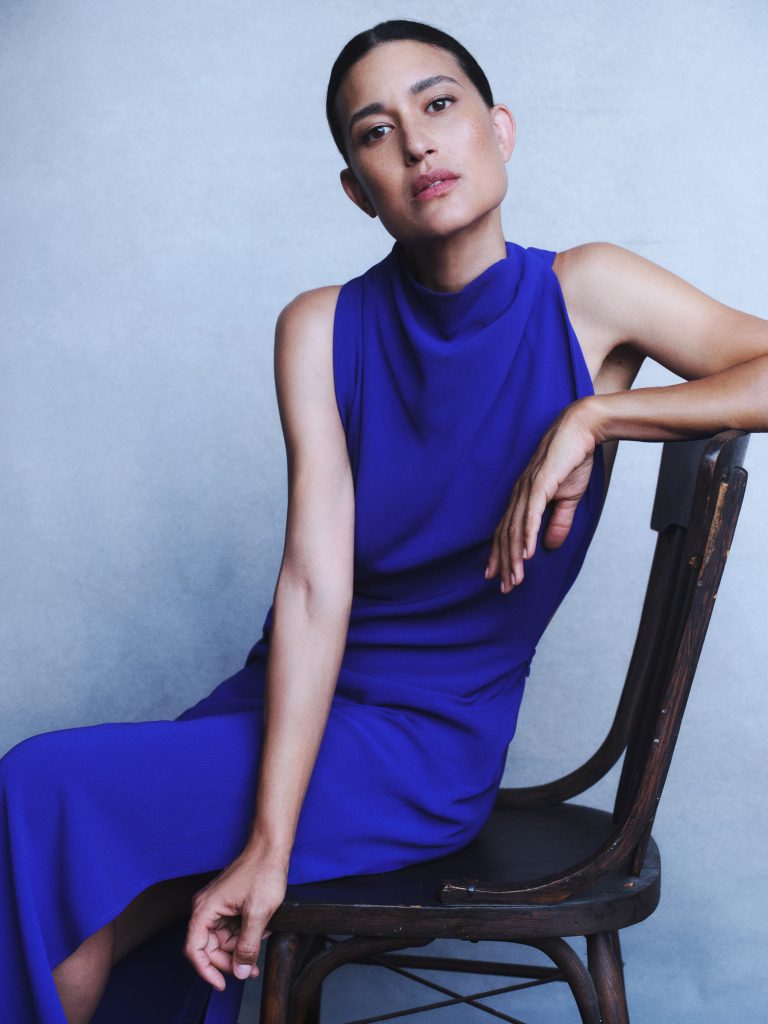
Photos by Jonny Marlow
There is a particular confidence that arrives when someone finally stops trying to become the person everybody else expected. Julia Jones seems to know something about that. When we speak, she is in Berlin, preparing for a project she is absolutely not allowed to discuss, which is both frustrating and somehow appropriate for an actress whose career has increasingly been defined by refusing the obvious next move. “It’s all under wraps for now,” she says, laughing. “But it’s exciting. It’s fun. I’m sure you’ll hear about it soon.” Jones has spent much of her career moving between worlds: independent film and blockbuster franchises, Los Angeles and New York, acting, and now writing. There is a sense that the movement itself has become the point. She grew up in Boston, studied in New York and began modeling as a teenager before making her first independent film during college. Acting, however, had been sitting somewhere inside her since she was eight. Her parents, both professionals, wanted education and stability; Jones wanted the considerably less predictable life of an actor. College became complicated not because she disliked learning—she describes herself now as deeply curious—but because she already knew what she wanted to do. Eventually the pull became impossible to ignore. With a semester remaining, she left for Los Angeles, later returning to finish her degree. “I just knew that I wanted to do this,” she says. “I was all in.”
That decision would eventually produce the kind of career that looks remarkably tidy when reduced to a list of credits and considerably less tidy when actually lived. Jones has moved through projects as varied as The Twilight Saga: Eclipse, The Twilight Saga: Breaking Dawn – Part 1, Wind River, The Mandalorian, Dexter: New Blood and Echo, developing the unusual ability to appear entirely at home whether surrounded by Hollywood machinery or the intimacy of a smaller character-driven production. Yet the more revealing story may be what happened before the credits accumulated.
Jones talks candidly about growing up multi-ethnic and the difficulty, particularly when she was younger, of trying to understand which box she was supposed to occupy. “I never fit into any box,” she says. At first, that was difficult. Eventually, it became liberating. New York helped. So did answering more fundamental questions: What did she want? What made her happy? Who was she when she stopped concentrating on who she was “supposed” to be?
Perhaps that is why Jones now speaks so convincingly about instinct. Resistance from her family to acting, rather than sending her back toward the safer path, forced her to become better at hearing herself. “I learned to really listen to my gut,” she says, because the alternative was making her profoundly unhappy. There is no suggestion of resentment in the telling. If anything, age has allowed her to see the contradiction with some tenderness: parents who insisted their children should discover who they were while also maintaining fairly definite ideas about how that discovery ought to proceed.
“I learned to really listen to my gut.”
Before acting, there was ballet, another early education in the difference between wanting something and doing the work required to achieve it. Jones began at four or five and was serious about it. Then she grew taller, her body changed, ballet gave way to modern and jazz, and eventually dance ceased to be the center of her life. The discipline, however, never left. “It isn’t magic, it’s not just talent,” she says. “It’s a lot of very hard work.” That may be as concise a description of acting as any. It also explains something about Jones’s attitude toward fear. Asked what she might tell her teenage self, she reverses the premise: perhaps the teenager should be advising the adult. At fifteen or sixteen, she says, she believed she could do anything. Then experience arrived, accompanied by rejection, explanations, reasons and limitations. Adulthood can become an education in why things supposedly cannot happen. “In some ways I was the most fearless when I was a teenager,” she says. Now she is trying to relearn some of that fearlessness, to “undo some of the learning.” It is an unexpectedly revealing admission from someone with a substantial career behind her, but it also helps explain why the next chapter looks increasingly expansive.
“In some ways I was the most fearless when I was a teenager.”
The newest expansion is writing. For the past three or four years, Jones has quietly been working on a novel, fulfilling what she describes as a lifelong, bucket-list ambition. Books were her first escape as a child: portable worlds requiring neither batteries nor Wi-Fi. She studied English at college, but approaching a novel as its author rather than its reader proved another matter entirely. Working with editor Lexa Hillyer, Jones has essentially been learning the architecture of fiction while constructing the building. The experience has been consuming. “I have put more hours into this book than probably all of my acting combined,” she says. She is now deep in revisions, with the eventual publication timetable partly dependent on filming commitments.
More intriguing is what writing has unexpectedly done to her ambitions. Acting, she explains, eventually becomes instinctive: the preparation is done and then, when the camera rolls, she tries to live inside the moment. Writing demands a different kind of control. The novelist is responsible for everything: the room, the weather, the silence, the person walking through the door and what happens when they do. For Jones, taking responsibility for an entire fictional world has altered the way she looks at a film set. Directing, something she had never particularly imagined doing, suddenly seems possible. “Maybe directing one day,” she says, almost cautiously.
“Anybody could do it, because all you have to do is do it.”
Meanwhile there is The Weight, the new film Jones discusses with unmistakable affection, alongside Ethan Hawke and Russell Crowe. Her route into it began, wonderfully, with a late-night text from an old friend asking whether she could immediately come to Cecconi’s in Los Angeles. She was already on the couch. She did not go. The project, fortunately, came to her anyway. Eventually she connected with director Padraic McKinley, read the script and entered a long conversation about the character and the world around her. What convinced Jones was not simply the material but McKinley’s openness. Rather than defending every idea, he invited questions. “Let’s jump in together. Let’s figure it out together,” is how she remembers the spirit of those early conversations. The movie then proceeded to perform that familiar independent-film dance of almost happening, disappearing, returning, collapsing and returning yet again. When it finally came together, it came together quickly. Jones headed to Germany, where filming moved from studios near Munich into the Bavarian wilderness. The cast stayed together somewhere she jokingly compares to Dirty Dancing: isolated, communal, beautiful, except everyone would leave each morning for the middle of nowhere and return covered in dirt.
The struggle to make the film appears to have become part of why Jones loves it. At a moment when the industry can seem terrified of risk—retreating toward franchises, recognizable intellectual property and formulas with spreadsheets to prove their existence—The Weight felt different. They did not have an enormous budget, she says, but that limitation may ultimately have protected the film. “We snuck in,” she says, and the result is the movie its filmmakers actually wanted to make. There is something almost beautifully old-fashioned about that proposition: gather talented people, trust them and make the thing. It also suits Jones, whose career seems increasingly interested in precisely those spaces where certainty ends.
She is currently preparing the mysterious Berlin project, hopes to reunite with previous collaborators for another movie later in the year and must somehow find time between both to finish revising the novel. The future, in other words, is busy and deliberately difficult to categorize.
“It isn’t magic, it’s not just talent, it’s a lot of very hard work.”
Jones becomes most serious when the conversation turns to AI. She is not seduced by the novelty. Her instinctive reaction, she admits, is repulsion, particularly when AI begins replacing human creativity, connection and community. Yet she is pragmatic enough to recognize that simply wishing it away is not a strategy. The challenge, she argues, is working out where it can be useful and where boundaries must be imposed. She uses it herself for questions but treats the answer as a starting point rather than an authority.
Her larger fear is subtler: that convenience gradually removes abilities before we notice they have disappeared. She compares it to walking through a foreign city with Google Maps. Once, you unfolded a map, got lost, found yourself again and inadvertently learned the city. Now a blue dot tells you exactly where to turn. AI, she worries, could become an extreme version of that surrender—until people “stop using their brains, and stop using their creativity, and stop being present, and stop being human.”
Which brings us back, rather neatly, to Julia Jones herself: leaving college temporarily because acting would not wait, refusing to fit comfortably into a prescribed identity, moving between independent films and enormous franchises, writing a novel without knowing exactly how one writes a novel, and perhaps now contemplating a director’s chair she once had no interest in occupying. The secret may be that she has stopped requiring certainty before beginning. There will be more films. There will eventually be the novel, a project she describes as a labor that has occupied years of her life. And there may be directing. But the most interesting thing about Jones is the sense that, after years of learning how the world works, she is deliberately recovering a little of the teenager who believed she could simply decide what she wanted and go after it. Perhaps adulthood, at its best, is not about knowing better. Perhaps it is knowing better and being brave enough to try it anyway.
Photography: Jonny Marlow
Styling: Rebecca Ramsey @ The Wall Group
Hair: Clariss Rubenstein @ A Frame Agency
Makeup: Fiona Stiles @ A Frame Agency