
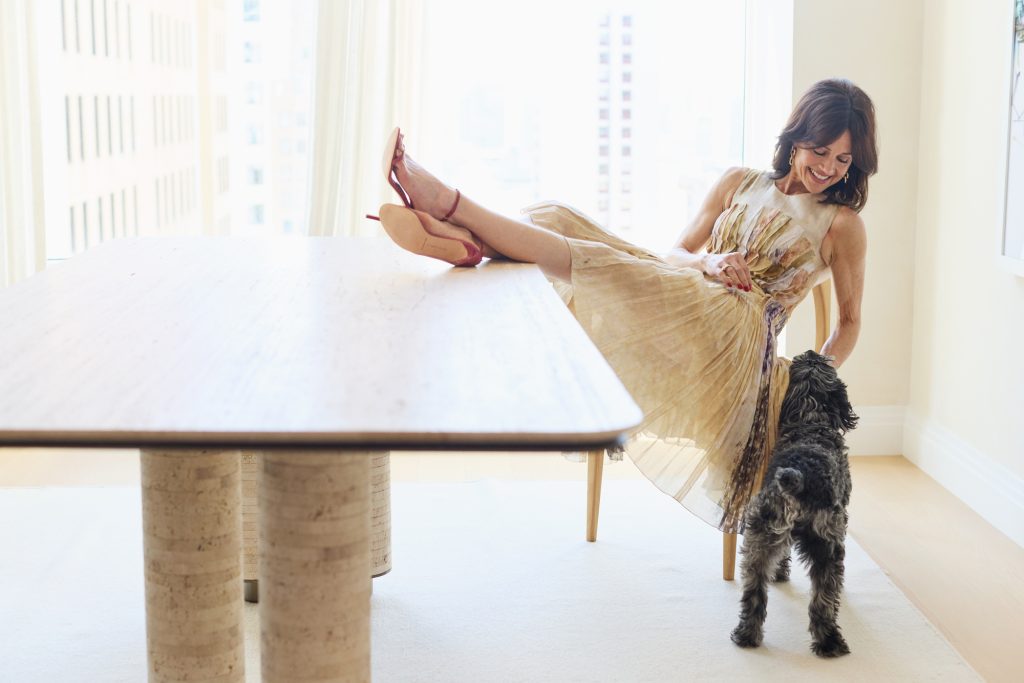
Prada, dress; Manolo Blahnik, shoes
After four decades in Hollywood, Carla Gugino has mastered the rarest trick in show business: remaining entirely herself while becoming almost anyone else. From teenage rebel to Hollywood leading lady, from David Fincher’s exacting world to the formidable Vivien Leigh, hers is a career built not on celebrity’s shifting fashions but on talent, instinct, and an admirable refusal to be ordinary.
By Moonah Ellison
Photos by Patrick Fraser
There is something wonderfully subversive about Carla Gugino. In an industry that has spent the better part of a century attempting to manufacture individuality by committee, she has committed the rather radical act of possessing some of her own. She is intelligent without making an exhibition of it, glamorous without appearing enslaved by the obligation, and sufficiently secure in her abilities to admit that she is still learning. Hollywood, which has never quite known what to do with women who refuse to fit conveniently into its filing cabinets, has nevertheless found itself employing her for more than forty years. One suspects the relationship has been considerably more rewarding for the audience than for the filing clerks.
When we speak, Gugino has just finished a day’s filming in San Francisco. Beyond her window are Coit Tower and Alcatraz, an appropriately cinematic arrangement for an actress currently immersed in Fog City, a noir drama set in the 1930s. Filming began in Australia before moving to the city where the story unfolds. She plays a character based on a real woman, and her enthusiasm for the material is unmistakable. There is no weary recitation of publicity-approved adjectives, no suggestion that another production is merely another entry on an already distinguished résumé. Instead, she talks about the pleasure of storytelling with the curiosity of someone encountering its possibilities for the first time.
It is an enthusiasm that began in circumstances rather less glamorous than a San Francisco hotel overlooking the bay. Born in Florida, the daughter of an orthodontist of Italian heritage, Gugino grew up moving between different worlds. Her father, Carl, gave her both her name and, apparently, a splendid set of teeth, having enthusiastically tested various orthodontic contraptions on his daughter. When she began acting professionally, advisers suggested that Gugino was too ethnic, too difficult to pronounce, too inconvenient for Hollywood’s delicate sensibilities. She considered alternatives, including Carla Burgess and Carla Neil, before deciding that the name she had inherited was rather more important than the prejudices of those recommending its disposal.
Her father died last year at 96, having, she says, lived the life he wanted. Looking back, she is profoundly grateful that she kept his name. What might once have seemed a minor professional calculation has become something infinitely more meaningful: a declaration of identity, continuity and affection.
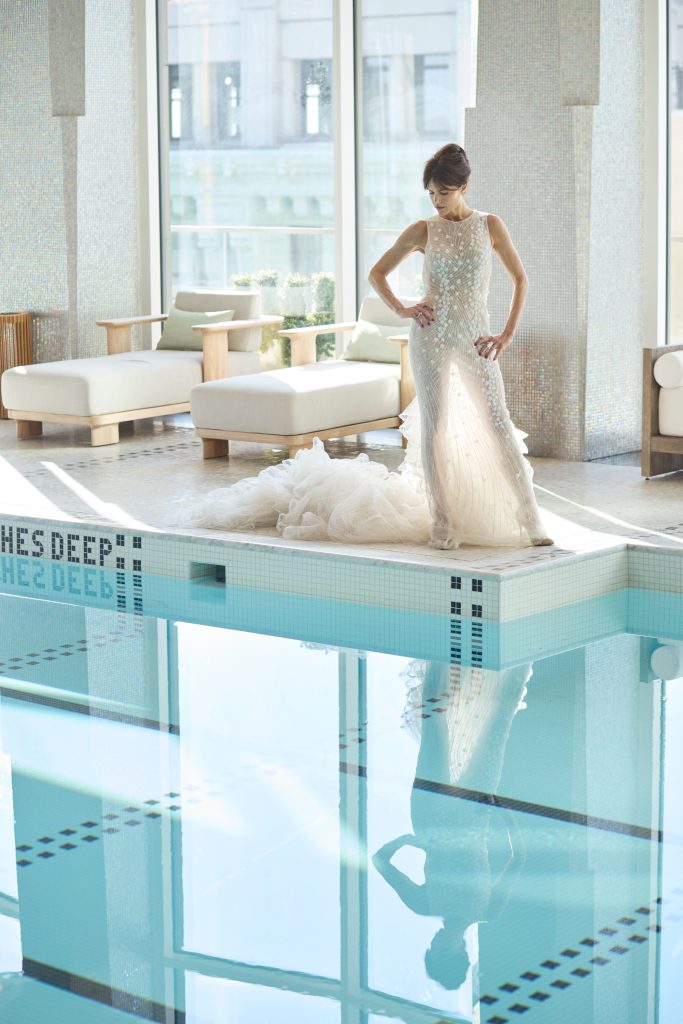
Beauté Comme Toi at The Confessional Showroom NYC, gown
Her route into acting was similarly governed by instinct rather than convention. Recruited by Elite Petite, she travelled to New York as a young teenager to pursue modeling, only to discover that the city’s formidable energy and the industry’s peculiar demands held considerably less appeal than anticipated. While her fellow models embraced Manhattan nightlife, Gugino was the California girl practising yoga and eating granola. An acting class in Los Angeles, suggested by her aunt Carol Merrill, changed everything. Under teacher Gene Bua, she discovered the exhilaration of surrendering control within the safety of a performance. For a serious, academically accomplished child accustomed to imposing order on an unpredictable life, the revelation was immediate. Acting offered freedom without chaos, discipline without confinement. She knew, with remarkable certainty, that she had found her vocation.
Early appearances in Webster, ALF, Who’s the Boss?, The Wonder Years and Doogie Howser, M.D. provided the apprenticeship. Then came Troop Beverly Hills, the 1989 comedy with Shelley Long that remains a cult favourite. Gugino recalls claiming to be fourteen when she was actually sixteen to secure the role, a small act of youthful deception that demonstrated a larger professional truth: an actor’s capacity for transformation should matter rather more than the biographical information available to a casting director.
Her career is a persuasive argument that genuine talent has no interest in being confined by other people’s expectations.
The decades that followed proved the point. From Spin City, where she formed an enduring friendship with Connie Britton, to Sin City, Entourage and Karen Sisco, Gugino moved between comedy, crime, drama and psychological complexity with an ease that made classification increasingly absurd. Her work in The Haunting of Hill House and The Fall of the House of Usher further demonstrated her ability to give emotionally demanding material an intelligence and humanity that spectacle alone cannot supply. She is equally at home in the fantastical and the painfully recognisable, a versatility that owes less to reinvention than to an unusually disciplined understanding of character.
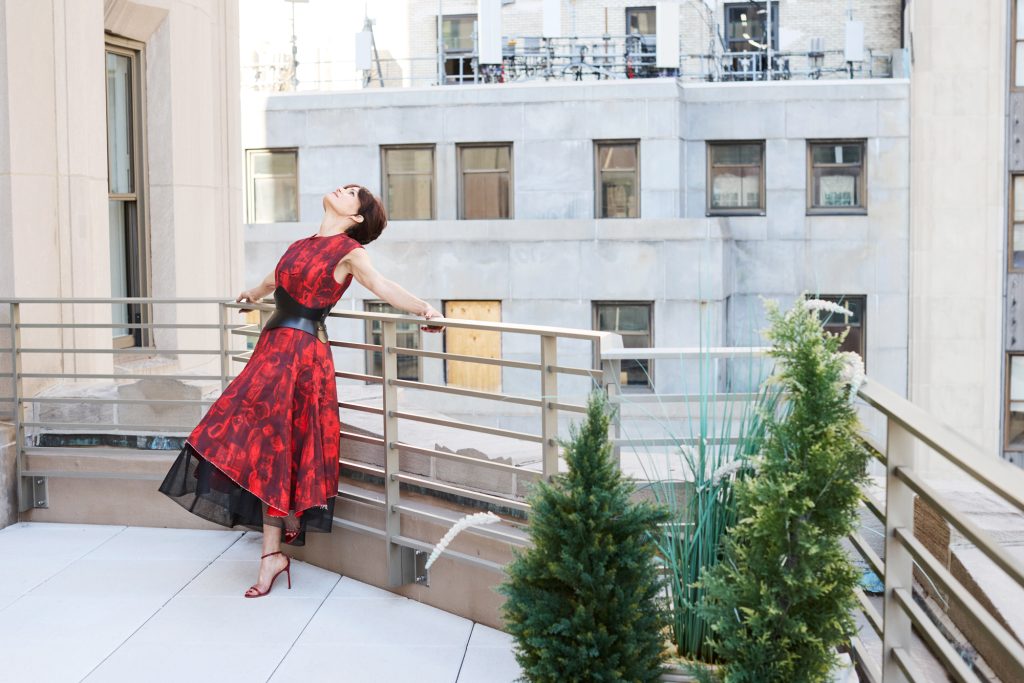
Jason Wu Collection, full look; Manolo Blahnik, shoes
That discipline has brought her into the orbit of David Fincher and The Further Mis-Adventures of Cliff Booth, the Brad Pitt-led follow-up to Quentin Tarantino’s Once Upon a Time in Hollywood. Set in 1977, the film revisits Cliff Booth in a different chapter of his life. Gugino describes a demanding audition process involving conversations, work sessions and a traditional screen test. After forty years of professional accomplishment, she was perfectly prepared to prove herself again. The result was an opportunity to work alongside Pitt, Elizabeth Debicki and Scott Caan under a director whose precision she finds liberating rather than restrictive. Fincher’s focused, almost phone-free set suits her temperament: serious about the work, generous in collaboration and refreshingly uninterested in unnecessary noise.
Her ambitions, however, extend beyond the camera. In a forthcoming independent film exploring the final year of Vivien Leigh’s life, Gugino assumes the role of the legendary actress while also serving as producer. Matthew Modine and David Hyde Pierce join the cast. The project required the unromantic business of raising money, navigating production difficulties and accepting responsibility for decisions that an actor can ordinarily leave to somebody else. Gugino relishes the challenge. She has little interest in ornamental producing credits, preferring to contribute meaningfully to every stage of filmmaking. It is a philosophy shared with her longtime partner and creative collaborator, Sebastian Gutierrez, and reflects her belief that the best work emerges when talented people are encouraged to contribute rather than instructed merely to obey.
For Gugino, artistic power is not the privilege of controlling others, but the opportunity to make something extraordinary together.
Her concerns about artificial intelligence reveal a similarly thoughtful approach to the future. She recognises its usefulness while questioning the wisdom of allowing commercial enthusiasm to outrun artistic protection. The possibility of performers losing control over their likenesses, or background actors being displaced by digital substitutes, troubles her. Yet her optimism about human creativity remains intact. Technology may imitate the products of imagination, she argues, but the human experience from which inspiration emerges is another matter entirely. It is an important distinction in an industry increasingly tempted to confuse efficiency with achievement.
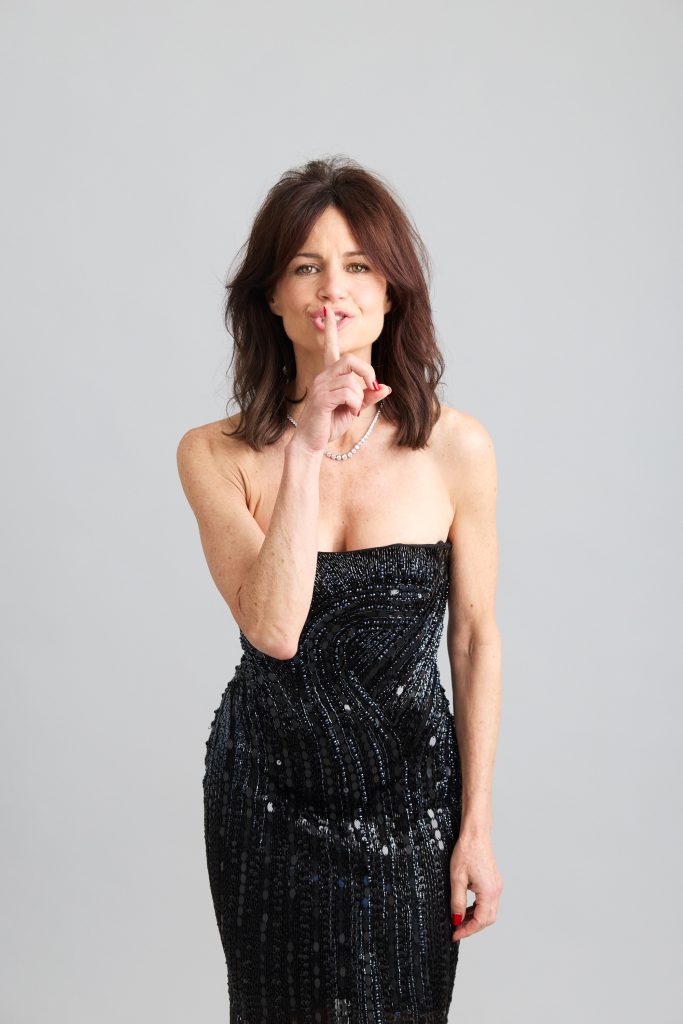
Francisco Arce, strapless, beaded fringe cocktail dress with crystal details; LEVIEV, necklaces
And then there is the theatre, a medium that demands precisely the immediacy, courage and emotional honesty she has spent a lifetime cultivating. Gugino is preparing for another major New York stage undertaking, a reminder that even an enviable screen career need not exhaust an artist’s ambitions. (Starting this November, Gugino will star opposite Sam Rockwell in the Off-Broadway revival of Arthur Miller’s A View from the Bridge at La MaMa’s Ellen Stewart Theatre.) Her return to New York Moves as a cover subject, and her participation in its Power Women celebration, provides an appropriate moment to consider the remarkable distance travelled since that young Californian first ventured onto Manhattan’s intimidating streets.
There is a temptation, when examining a career of such longevity, to describe it as a triumph of survival. But survival is a rather modest ambition, and Gugino’s accomplishments deserve a more generous vocabulary. She has not simply endured Hollywood’s changing fashions; she has demonstrated that intelligence, independence, humour and genuine artistic enthusiasm can flourish within them. The girl who refused to surrender her father’s name has become a woman who refuses to surrender her individuality. In an industry perpetually searching for the next new thing, Carla Gugino offers something considerably more valuable: the enduring pleasure of an original.
Photographer: Patrick Fraser
Fashion Editor: Cannon @ Atelier Management
Fashion Assistant: Winnie Paranoan
Hair: Sebastian Scolarici @ Tracey Mattingly
Makeup: Lisa Aharon @ The Wall Group
Location: One Wall Street, NYC