
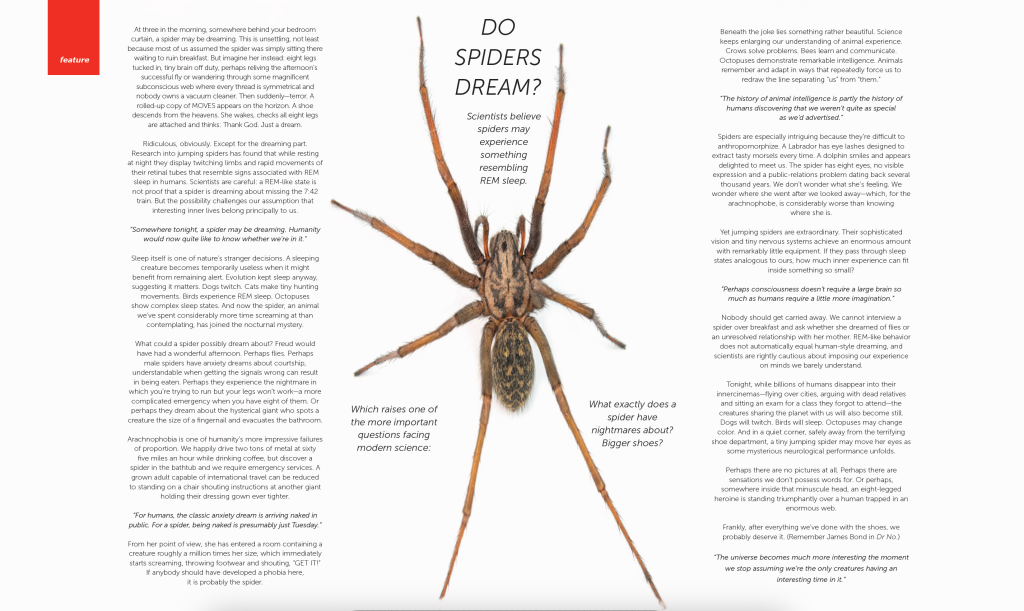
Scientists believe spiders may experience something resembling REM sleep. Which raises one of the more important questions facing modern science: What exactly does a spider have nightmares about? Bigger shoes?
By Ashley Monroe
At three in the morning, somewhere behind your bedroom curtain, a spider may be dreaming. This is unsettling, not least because most of us assumed the spider was simply sitting there waiting to ruin breakfast. But imagine her instead: eight legs tucked in, tiny brain off duty, perhaps reliving the afternoon’s successful fly or wandering through some magnificent subconscious web where every thread is symmetrical and nobody owns a vacuum cleaner. Then suddenly—terror. A rolled-up copy of MOVES appears on the horizon. A shoe descends from the heavens. She wakes, checks all eight legs are attached and thinks: Thank God. Just a dream.
Ridiculous, obviously. Except for the dreaming part. Research into jumping spiders has found that while resting at night they display twitching limbs and rapid movements of their retinal tubes that resemble signs associated with REM sleep in humans. Scientists are careful: a REM-like state is not proof that a spider is dreaming about missing the 7:42 train. But the possibility challenges our assumption that interesting inner lives belong principally to us.
“Somewhere tonight, a spider may be dreaming. Humanity would now quite like to know whether we’re in it.”
Sleep itself is one of nature’s stranger decisions. A sleeping creature becomes temporarily useless when it might benefit from remaining alert. Evolution kept sleep anyway, suggesting it matters. Dogs twitch. Cats make tiny hunting movements. Birds experience REM sleep. Octopuses show complex sleep states. And now the spider, an animal we’ve spent considerably more time screaming at than contemplating, has joined the nocturnal mystery.
What could a spider possibly dream about? Freud would have had a wonderful afternoon. Perhaps flies. Perhaps male spiders have anxiety dreams about courtship, understandable when getting the signals wrong can result in being eaten. Perhaps they experience the nightmare in which you’re trying to run but your legs won’t work—a more complicated emergency when you have eight of them. Or perhaps they dream about the hysterical giant who spots a creature the size of a fingernail and evacuates the bathroom.
Arachnophobia is one of humanity’s more impressive failures of proportion. We happily drive two tons of metal at sixty five miles an hour while drinking coffee, but discover a spider in the bathtub and we require emergency services. A grown adult capable of international travel can be reduced to standing on a chair shouting instructions at another giant holding their dressing gown ever tighter.
“For humans, the classic anxiety dream is arriving naked in public. For a spider, being naked is presumably just Tuesday.”
From her point of view, she has entered a room containing a creature roughly a million times her size, which immediately starts screaming, throwing footwear and shouting, “GET IT!” If anybody should have developed a phobia here,
it is probably the spider.
Beneath the joke lies something rather beautiful. Science keeps enlarging our understanding of animal experience. Crows solve problems. Bees learn and communicate. Octopuses demonstrate remarkable intelligence. Animals remember and adapt in ways that repeatedly force us to redraw the line separating “us” from “them.”
“The history of animal intelligence is partly the history of humans discovering that we weren’t quite as special as we’d advertised.”
Spiders are especially intriguing because they’re difficult to anthropomorphize. A Labrador has eye lashes designed to extract tasty morsels every time. A dolphin smiles and appears delighted to meet us. The spider has eight eyes, no visible expression and a public-relations problem dating back several thousand years. We don’t wonder what she’s feeling. We wonder where she went after we looked away—which, for the arachnophobe, is considerably worse than knowing where she is.
Yet jumping spiders are extraordinary. Their sophisticated vision and tiny nervous systems achieve an enormous amount with remarkably little equipment. If they pass through sleep states analogous to ours, how much inner experience can fit inside something so small?
“Perhaps consciousness doesn’t require a large brain so much as humans require a little more imagination.”
Nobody should get carried away. We cannot interview a spider over breakfast and ask whether she dreamed of flies or an unresolved relationship with her mother. REM-like behavior does not automatically equal human-style dreaming, and scientists are rightly cautious about imposing our experience on minds we barely understand.
Tonight, while billions of humans disappear into their innercinemas—flying over cities, arguing with dead relatives and sitting an exam for a class they forgot to attend—the creatures sharing the planet with us will also become still. Dogs will twitch. Birds will sleep. Octopuses may change color. And in a quiet corner, safely away from the terrifying shoe department, a tiny jumping spider may move her eyes as some mysterious neurological performance unfolds.
Perhaps there are no pictures at all. Perhaps there are sensations we don’t possess words for. Or perhaps, somewhere inside that minuscule head, an eight-legged heroine is standing triumphantly over a human trapped in an enormous web.
Frankly, after everything we’ve done with the shoes, we probably deserve it. (Remember James Bond in Dr No.)
“The universe becomes much more interesting the moment we stop assuming we’re the only creatures having an interesting time in it.”