
Pride is one of the strangest emotions in the human repertoire. We are proud of our intelligence, beauty, careers, resilience, wealth, children, nationality, sometimes even our height. Yet beneath almost every declaration of pride lies an uncomfortable question: how much of any of it did we actually choose?
By Richard Peters
None of us chose to be born. We did not select our parents, genes, brains, bodies, temperaments or natural abilities. We did not decide whether we would arrive with perfect pitch, extraordinary memory, physical strength, mathematical brilliance, crippling shyness or an effortless ability to charm a room. We did not choose our country, childhood wealth or poverty, education, or whether our earliest experiences taught us that the world was safe or dangerous. We simply arrived.
Being proud of beautiful eyes makes roughly as much logical sense as being proud of having been born on a Tuesday. But intelligence, talent and achievement present a more complicated problem. A brilliant mathematician may work extraordinarily hard, but she did not choose the brain that allowed mathematics to make sense to her. A great athlete may train relentlessly, but he did not order the lungs, reflexes or coordination that made elite performance possible. We respond: But they worked for it.
Certainly. But where did their ability to work for it come from?
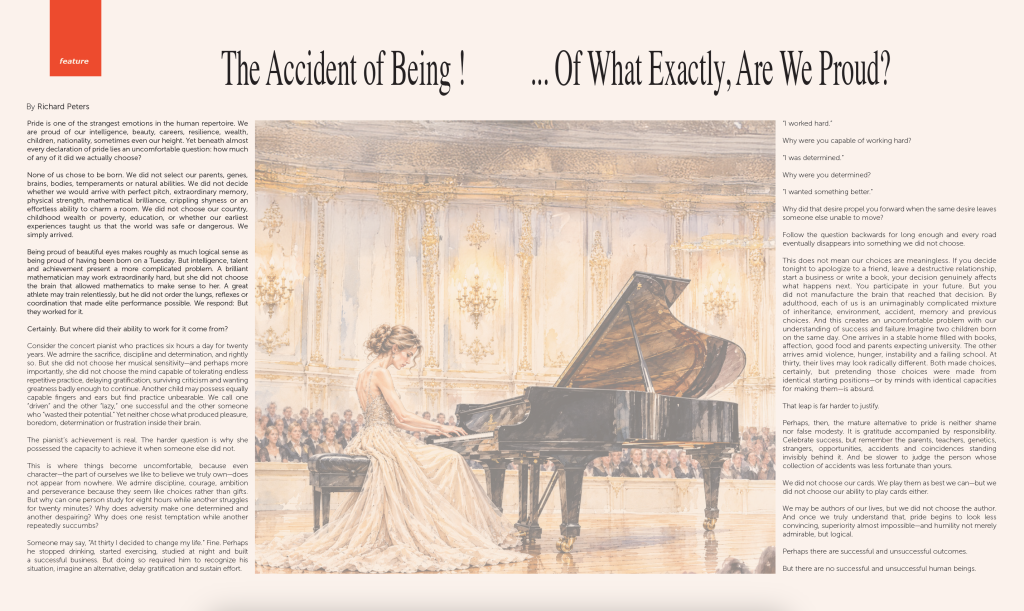
Consider the concert pianist who practices six hours a day for twenty years. We admire the sacrifice, discipline and determination, and rightly so. But she did not choose her musical sensitivity—and perhaps more importantly, she did not choose the mind capable of tolerating endless repetitive practice, delaying gratification, surviving criticism and wanting greatness badly enough to continue. Another child may possess equally capable fingers and ears but find practice unbearable. We call one “driven” and the other “lazy,” one successful and the other someone who “wasted their potential.” Yet neither chose what produced pleasure, boredom, determination or frustration inside their brain.
The pianist’s achievement is real. The harder question is why she possessed the capacity to achieve it when someone else did not.
This is where things become uncomfortable, because even character—the part of ourselves we like to believe we truly own—does not appear from nowhere. We admire discipline, courage, ambition and perseverance because they seem like choices rather than gifts. But why can one person study for eight hours while another struggles for twenty minutes? Why does adversity make one determined and another despairing? Why does one resist temptation while another repeatedly succumbs?
Someone may say, “At thirty I decided to change my life.” Fine. Perhaps he stopped drinking, started exercising, studied at night and built a successful business. But doing so required him to recognize his situation, imagine an alternative, delay gratification and sustain effort.
“I worked hard.”
Why were you capable of working hard?
“I was determined.”
Why were you determined?
“I wanted something better.”
Why did that desire propel you forward when the same desire leaves someone else unable to move?
Follow the question backwards for long enough and every road eventually disappears into something we did not choose.
This does not mean our choices are meaningless. If you decide tonight to apologize to a friend, leave a destructive relationship, start a business or write a book, your decision genuinely affects what happens next. You participate in your future. But you did not manufacture the brain that reached that decision. By adulthood, each of us is an unimaginably complicated mixture of inheritance, environment, accident, memory and previous choices. And this creates an uncomfortable problem with our understanding of success and failure.Imagine two children born on the same day. One arrives in a stable home filled with books, affection, good food and parents expecting university. The other arrives amid violence, hunger, instability and a failing school. At thirty, their lives may look radically different. Both made choices, certainly, but pretending those choices were made from identical starting positions—or by minds with identical capacities for making them—is absurd.
That leap is far harder to justify.
Perhaps, then, the mature alternative to pride is neither shame nor false modesty. It is gratitude accompanied by responsibility. Celebrate success, but remember the parents, teachers, genetics, strangers, opportunities, accidents and coincidences standing invisibly behind it. And be slower to judge the person whose collection of accidents was less fortunate than yours.
We did not choose our cards. We play them as best we can—but we did not choose our ability to play cards either.
We may be authors of our lives, but we did not choose the author. And once we truly understand that, pride begins to look less convincing, superiority almost impossible—and humility not merely admirable, but logical.
Perhaps there are successful and unsuccessful outcomes.
But there are no successful and unsuccessful human beings.