
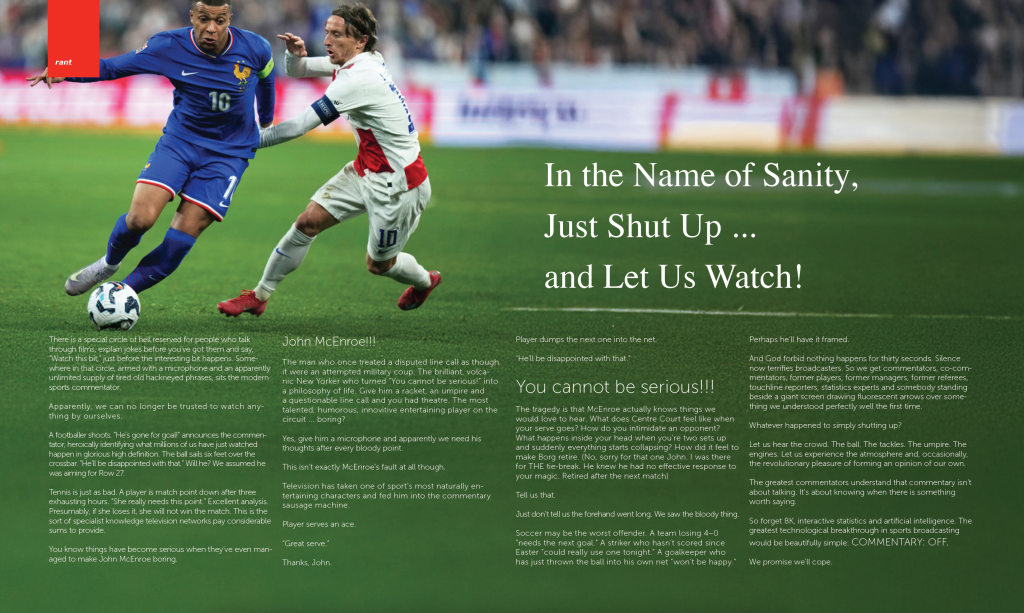
There is a special circle of hell reserved for people who talk through films, explain jokes before you’ve got them and say, “Watch this bit,” just before the interesting bit happens. Somewhere in that circle, armed with a microphone and an apparently unlimited supply of tired old hackneyed phrases, sits the modern sports commentator.
Apparently, we can no longer be trusted to watch anything by ourselves.
A footballer shoots. “He’s gone for goal!” announces the commentator, heroically identifying what millions of us have just watched happen in glorious high definition. The ball sails six feet over the crossbar. “He’ll be disappointed with that.” Will he? We assumed he was aiming for Row 27.
Tennis is just as bad. A player is match point down after three exhausting hours. “She really needs this point.” Excellent analysis. Presumably, if she loses it, she will not win the match. This is the sort of specialist knowledge television networks pay considerable sums to provide.
You know things have become serious when they’ve even managed to make John McEnroe boring.
John McEnroe!!!
The man who once treated a disputed line call as though it were an attempted military coup. The brilliant, volcanic New Yorker who turned “You cannot be serious!” into a philosophy of life. Give him a racket, an umpire and a questionable line call and you had theatre. The most talented, humorous, innovitive entertaining player on the circuit … boring?
Yes, give him a microphone and apparently we need his thoughts after every bloody point.
This isn’t exactly McEnroe’s fault at all though.
Television has taken one of sport’s most naturally entertaining characters and fed him into the commentary sausage machine.
Player serves an ace.
“Great serve.”
Thanks, John.
Player dumps the next one into the net.
“He’ll be disappointed with that.”
You cannot be serious!!!
The tragedy is that McEnroe actually knows things we would love to hear. What does Centre Court feel like when your serve goes? How do you intimidate an opponent? What happens inside your head when you’re two sets up and suddenly everything starts collapsing? How did it feel to make Borg retire. (No, sorry for that one John. I was there for THE tie-break. He knew he had no effective response to your magic. Retired after the next match)
Tell us that.
Just don’t tell us the forehand went long. We saw the bloody thing.
Soccer may be the worst offender. A team losing 4–0 “needs the next goal.” A striker who hasn’t scored since Easter “could really use one tonight.” A goalkeeper who has just thrown the ball into his own net “won’t be happy.”
Perhaps he’ll have it framed.
And God forbid nothing happens for thirty seconds. Silence now terrifies broadcasters. So we get commentators, co-commentators, former players, former managers, former referees, touchline reporters, statistics experts and somebody standing beside a giant screen drawing fluorescent arrows over something we understood perfectly well the first time.
Whatever happened to simply shutting up?
Let us hear the crowd. The ball. The tackles. The umpire. The engines. Let us experience the atmosphere and, occasionally, the revolutionary pleasure of forming an opinion of our own.
The greatest commentators understand that commentary isn’t about talking. It’s about knowing when there is something worth saying.
So forget 8K, interactive statistics and artificial intelligence. The greatest technological breakthrough in sports broadcasting would be beautifully simple: COMMENTARY: OFF.
We promise we’ll cope.